Archive | Dashwood

Private: Our poker king retains his crown

No Gravatar

Richard Webb wins second Canadian Poker Tour title

Story and file photo by Casey Lessard

Canadian Poker Tour champion Richard Webb will retain his crown after winning the championship this weekend in Calgary, Alberta. The Grand Bend resident beat the tour’s 50 best players, and wins a second $100,000 contract that pays for his travel and entry fees to tournaments around the world.
“I think I’m happier the second time,” Webb said in a phone interview from Calgary. “It was a tougher field this time with even better players.”
In addition to the $100,000 contract, Webb took $12…

Posted in Dashwood, Grand Bend, News, VIPs0 Comments

“We have to go ahead.”

No Gravatar

Lambton Shores mayor wants low-pressure sewers before infrastructure funding runs dry

The Lambton Shores sewage treatment plant and Zone 3 sewer network could be the last project mayor Gord Minielly is involved in before he retires. Casey Lessard sat down with the mayor to discuss the projects.

Why is this project necessary now?
We just spent a big chunk of money on our beach, and any day you have a beach closing, it’s a negative for us. The Blue Flag designation will put up with two or three per summer. Our water comes south from Bluewater. If we can get them on sewers along with South Huron and us, we’re not going to be affecting the quality of the water in the Grand Bend area. It makes it safer for our visitors and our residents, and gives us a positive over some other areas in Ontario that are having more pollution days. We were lucky last year and had very few, but if you look a few years ago, we were closed many days. Whether it was our fault or animal runoff, we don’t know. If we can take care of our part, then we’ll know.

Where are you at today?
I’ve asked Maria (Van Bommel, Lambton-Kent-Middlesex MPP) to set up a meeting with the infrastructure minister for us to firm up whether there’s going to be two-thirds funding for us. When we met with David Caplan, he thought it was a great idea; “Do the plant first and come on back.” We’re going back to see if we can get that two-thirds funding, and if we do, Caplan told us 2014 was the cutoff. I would hope we can get some funding by 2012 and be completed along with Bluewater and South Huron by 2014.
There are effects going on in the water table that are not positive. I know people in Grand Bend are environmentally friendly, so I think we will get this done to the liking of the majority. Right now it doesn’t seem that popular, but the reality is, we are treating that water in a negative way. The lake water and the groundwater levels are the same, so it’s flowing into the lake. If we clean up our act, we can’t be blamed any more when there’s high E. coli; it’s got to be coming from runoff or something else.
One of the main reasons you feel you need to do this now is because of the money, right?
Two-thirds funding is not going to be here long. I suspect based on the deficits the province and Canada are going to have, there won’t be any money past 2014 while they try to clean up their debt. I think now is the most financially possible time to do it. If we can get two-thirds funding, it’s not going to be a burden. If we can spread it over 12-15 years, I think it will be doable for most people.

I was reading in the tri-municipal meeting minutes (where the three municipalities are discussing plans to build a shared treatment plant) that South Huron CAO Roy Hardy had spoken to someone who said there was no money.
I was at the same meeting that Roy was at, and I didn’t hear that. He was talking to people who were nervous about the downturn in the economy, but I have spoken with some of the ministers and as far as I know the stimulus package is going to continue because the economy is still in a trough, and they plan on doing what they planned in the beginning, which is going to 2014 and spending that money. Roy has his opinion about many things, and we don’t often see eye-to-eye, but the fact that we’re on track to get an appointment with the minister tells me they’re willing to talk to us; they must think this is going to continue on.

Is that the stumbling block from South Huron’s perspective? Is it the money or something else?
I have no idea. If you read the Lakeshore Advance, I made the comment that I thought we had a deal. Mayor Oke commented that he thought we had a deal but it wasn’t in the minutes. Mayor Oke didn’t come to the next meeting and it was in the minutes. It’s ready to be signed and we’ve invited them to come to a meeting in a couple of weeks and Bluewater and South Huron will hopefully sign along with us and then move on to the collection system.
That’s the sewage processing plant, which is quite a big project in itself. But that’s a separate project.
We got $15 million of infrastructure funding, and we have to add in another $5-7 million depending on how the tenders come in. But we have additional funding for energy efficiencies like solar panels.

And you do have that money secured?
Yes, we have $17 million of the total cost, so we’re well on our way to having that looked after. When that’s done, we hope to have the collection system ready to go if not in the process already.
Do you think that regardless of whether South Huron comes on board that you will go ahead with it?
We’re definitely going to build the plant. We have the funding, and it’s needed. We have no capacity for development, they have no capacity for development. Certainly Bluewater wants to get in there so they can clean up their beach-front. So for me, we have to go ahead. There’s no debate.

You’ve said changes are “coming down the pike”. What did you mean by that?
I’ve chatted with people from the ministry, and you can see that in Bruce they’re doing mandatory inspections of septics, and if your septic isn’t working, then you’re being forced to upgrade. The upgrades are not typically the normal. A gentleman told me the other day that he paid $18,000 for one that he had to redo. Would you rather do that and have something that will last 15-20 years or a permanent collection system you can depend on?
The question of whether it’s low-pressure or gravity is still being debated. Maybe we can do a combination. I know in Bayfield they have several low pressure tanks operating for the last 10 years with no maintenance. Maybe in the less dense areas we can use those and in the more dense areas, we can use gravity. But it’s twice as expensive, so it’s a debate that hasn’t been completed.

I’ve seen the numbers; will it be twice as much overall or per house?
I think it’s an overall view. Where I live, my sewer is 17’ down. When you excavate that far down, you have to have a much wider hole. In places like Beach o’ Pines, we’d have to excavate the road and probably damage many trees trying to get down so you do have a flow. We have to look long and hard. Doing gravity feed is not environmentally friendly; if you have a greenfield site, it’s not bad, but when you have a woodfield like that, it’s pretty bad for devastation. Then you have to rebuild all those roads and it’s part of the cost. The low-pressure system is less intrusive.

The gravity system construction would also take the roads from having a cottage feel to having new roads like downtown, right?
People like it that way (narrower roads) because it forces people to drive slow. Fix them up and put them in (to standard) and they’ll be like speedways. Walking to the beach will be more scary than it is today. But the fact is it’s much more expensive.

You spoke of development at the meeting. What is the vision for how these communities should look in the future? Should they always have the style of roads they have now or should they be at today’s standards?
Any new development will have 66’ roads with proper sewer lines. Southcott Pines and those subdivisions built them purposely (narrow) because they don’t want visitors coming in and out. Unless their board makes a decision, the roads will be like that until they change. They were designed that way and will stay that way. (But with gravity) there certainly would be a lot of damage. I suspect they would have to be (restored to the new standard).

Of the three options – gravity, low-pressure, and septic tanks – which one makes the most sense to you?
In my opinion, in the areas along the lake, the low-pressure is the least intrusive, the least expensive, and based on what I know about those pumps, should be as good as the gravity feed.
The issue with no power, I don’t know how many of the folks in there have generators, but I suspect it’s a lot. Our power grid around here is not what it used to be, and when you’re out for 24 hours, especially when it’s cold, you either have to move or have some form of heat. Especially along the lake in the gated communities, the low-pressure makes the most sense.
In new developments, the gravity feed makes sense. It makes lots more expensive because the contractor is responsible for that cost. I don’t know if we can do this one way and the other. That’s why it’s hard to answer questions because we don’t have the answers. Hopefully by this time next year, we’ll have a plan in place they can go forward with.

When I look at the numbers of people affected by this, the count I saw was 1500 homes in Lambton Shores that don’t have sewers. How many people are there year round?
I don’t know. In Beach O’ Pines, it’s likely the majority (that aren’t there). That’s changing. If I look down the road 15 years, I see Grand Bend having two-storey buildings all along Main Street with business on the main floor and apartments above.

How important is it to have services like this?
I’ve moved around Ontario and I always tried to find places that had sewers. I’m sure the tiles in Huron Woods are being filled with tree roots. A sealed low-pressure system doesn’t allow roots in, while a gravity feed does.

What is your current feeling about what people think about what you’re proposing?
I’ve been elected one way or another, sometimes in and sometimes out, over the last 30 years. Change doesn’t come easily to the average person. Here in Forest, the fire hall had been let go and we decided to build a new one. People threatened us and we had public meeting where people yelled at us. Carnegie Library wasn’t wheelchair accessible and we built a new library; I lost an election over that because I was the chairman of the committee that put it together. But the reality is that once it’s done, people go on with their lives and say, “Isn’t that a lovely library? What a beautiful fire hall.” People have difficulty with change and if it hurts them in the pocketbook, they have greater difficulty.

What is the actual cost per household expected for the sewer project?
We haven’t figured out the final numbers. I suspect that probably by spring, we should have those numbers down. We have to go to the ministry with firm numbers. I’d like to get them done sooner, but there are some decisions we have to make first. If your septic system is five years old, how long will you be grandfathered? If you grandfather nobody, there’s more people to pay for what you’re doing. If someone put one in yesterday and spent $20,000, it’s hard to ask them to cough up another $12,000-15,000.
The other thing we have to do is, if someone wants to build tomorrow, do they put in something less expensive than a whole septic system?

If the province and federal government do not have the money for this project, will it happen?
I guess I could answer that by saying I won’t be the mayor when that decision is made. Depending on the council of the day, and how much they think this is important, they will make that decision. Personally, I think there’s a 50-50 chance we will get funding. We have a good argument to make: we have a great beach, we’re trying to be as environmentally friendly as we can, and we need their help in getting us there. Tourism has been down in Ontario, but we are a destination and they know that. I have a good feeling we’re going to get some funding. I said that about the plant and it came through, and I hope it carries on. We’ve been very fortunate.

What is the timeline on this decision?
We’re trying to get a meeting for mid-December with Gerry (Phillips, infrastructure minister), and if we get some positive news there, I suspect we’d talk to him at the OGRA (Ontario Good Roads Association) convention in February, give him an update on numbers. The environmental assessment in Bluewater and South Huron, so they should have good numbers by then. I emailed them to say we were arranging this meeting and to ask if they’d be interested in coming. I got an immediate response from Bluewater and I’m still waiting for South Huron because they don’t want to play with us. Hopefully they come around. We’re meeting in Varna again and hopefully they’ll be there and sign the agreement so we can go to Toronto.

When do you think you’ll have something to tell people in the community?
At the latest in May, and at the earliest before we go to Toronto in February. I don’t think we need to have a meeting. We’ll put it out at a council meeting and I’m sure everyone will hear very quickly. Toronto and Ottawa have treated us very well, and other municipalities are jealous of the success we’ve had. I don’t think there will be money after 2014 for a long time.

Posted in Dashwood, Grand Bend, News, St. Joseph, VIPs0 Comments

“Stop the sewage plant and stop the sewers”

No Gravatar

Southcott Pines resident Dr. Carl Belke retired from Brandon University after 31 years teaching chemistry. Dick Matzka has cottaged in Southcott for 58 years. Neither is in favour of the sewer project proposed.

What are your concerns?
Dick: There are two major concerns. One is the expenditure the township plans on making. Two is that they keep telling people they’re going to get financial support from the province. A letter from the tri-municipal meeting says the province is not going to be able to assist them. Apparently there’s $8 million in the Build Canada fund, and it’s going to go to major metropolitan areas (Mayor Gord Minielly’s disputes this).
Carl: I’m concerned that they present the numbers correctly. Let the people decide if there’s a problem or if there isn’t a problem. How big of a problem is it and is it worth spending the money on a sewer system?

They mentioned nitrates at the meeting as being a concern. How do nitrates become part of the ecosystem as a result of human activity?
Belke: Our elimination process puts out ammonia and nitrogen products from the metabolism. The bacteria found in most systems are aerobic, which means ammonia gets converted to nitrate. Nitrate is very soluble. It’s an excellent fertilizer and plants require it. Nitrates can cause algae in the lake, but it’s good for plants. If you give nitrate anaerobic bacteria, that turns it into nitrogen gas, and our atmosphere is mostly nitrogen.
The limit for nitrates in drinking water is 10 parts per million. If you look at Pinery Park, the level is 0.2 ppm. If you look at Southcott, the average here is 3.1 ppm. If you compare that to what the river is putting into the lake – mostly from farmers’ fields – they’re about the same as what we’re doing.
Golder says we’re polluting the water, but who knows what the level was before we were here in the 1950s. We have geese here that contribute a lot of waste and that contributes to the nitrates.
Dick: They’re going to build a sewage plant and they don’t have to. The plant is going to pump more nitrate into the river than they allow.

Is the plant necessary?
Carl: Yes, in one respect. The Clean Water Act says any new development will have to have both municipal drinking water and municipal sewers.
In 2006, Dillon recommended a plant that would cost $13 million and a sewage collection system that would cost $40 million. Fast forward to 2009, the plant will cost $23 million. At the meeting the man from Dillon said the cost had gone up by 25 per cent. But it’s gone up 73 per cent. What’s the collection system going to cost? Sixty-eight million (based on extrapolating the numbers by 73 per cent)?
Dick: And they’re not finished with the plan. We’re only talking about 1500 homes in Lambton Shores. This town operates full bore for three months. For nine months it’s low key and casual. We’re spending a tremendous amount of money for a project that’s not necessary.

Carl, you hoped to speak at the meeting. What did you want to present?
Carl: I wanted to present the analytical data on the water wells in a normal light. They directed it to one parameter and ignored everything else to scare people that everything is bad. Maybe it is bad, but is it as bad as they say? Since no one in the area is on well, no one is directly affected by the drinking water.

You’re saying it’s still bad. What do we do to fix that?
Carl: Have better septic systems, I guess. The problem is, none of the septic systems here are inspected. Everyone waits until there’s a problem.

There are three choices: low-pressure, gravity and septic tanks. What is the most logical or best situation?
Carl: If they were honest with the numbers, the best we can do is let the people decide. I don’t think there is a pollution problem, and we’re not going to be growing in this neck of the woods (Southcott Pines).
Dick: I firmly believe that septics have done the job over the last 50-70 years. We should stop the sewage plant, grow the lagoons, and stop the sewers in the dunes area completely.

Posted in Dashwood, Grand Bend, News, St. Joseph0 Comments

Richard Webb: Low-pressure should be the last choice

No Gravatar

Industry professional thinks septic tanks are fine, gravity next best option

Richard Webb of Stewart Webb & Sons has been installing, repairing and replacing septic tanks and sewer line connections for more than 20 years. His family has been in the excavating business for more than 75 years.
The Strip asked the Southcott Pines resident for his expert advice about the sewer project plans.

As told to Casey Lessard

It would greatly benefit us, but I don’t see the benefit of spending the money if it’s not necessary. Certainly if it can be proven that huge of a negative effect on the environment, but we’ve done all we can to protect the environment. The septic systems here work properly.
There’s thousands and thousands of dollars that we would earn if sewers went ahead. For the amount of repairs that we do in septic systems, we might do 10-15 installs a year. If the sewers went ahead, our company would have work unlimited for 10 years. Then there’s the repair work after.
For the people in this area right now, private septic systems are the way to go. If they’re going to force us to go to sewers, a shallow-dug gravity system, meaning 5-6’ deep along the road with pumps in our basements would be my choice. A low-pressure system would be my last choice.
If they’re going to force people to put in sewers, don’t do low-pressure systems. From a maintenance standpoint, with pump chambers, they’re just a maintenance nightmare. If you’re going to install sewers, make sure they’re gravity fed.
The low-pressure system is not commonly used. It’s not a preferred method. Let’s say there are 20 houses on a street and 18 of them are owned by people who only come to Grand Bend in the summer time. The remaining two pumps have to push your effluent down the street to a central boosting area. When the system was designed, it was built so 12-13 pumps were kicking in. What’s it going to work like? That’s what the engineers are going to have to answer.
They’re trying to put in low-pressure sewers with as little disturbance as possible, but that doesn’t mean it’s the right way to do it. Why not pump the sewage from several main pumps instead of pumps on each individual property?

I feel they’re trying to fund this sewage lagoon expansion project and they need to have a certain number of homes using this system. I’m a big advocate of future development. But here in Southcott, in VanDongen, in Beach O’ Pines, we all sit on good soil for private septic systems. There’s more than enough area and the load rates are acceptable to have private septic systems on these lots.
Before they considered the water quality, they had a signed, sealed and delivered deal that everyone was going to be on sewers. We convinced them to come back with some data, and the highest readings that came back were from the oldest area in Southcott and the highest load areas; the highest readings were 5.5 ppm, and the acceptable limits for drinking water are 10 ppm.
We take sand from excavations here, take it back from the site and reuse it in septic systems to the north in the clay. We know the sand has a T time (percolation rate) from 3 to 6 minutes per centimetre. That’s the time the water takes to pass through the material. We know that’s an acceptable rate.
In Bluewater, they need sewers. The lots are too small and the clay conditions are too heavy to make a septic system work properly. In clay, they have a T time of greater than 50 min/cm. It needs to be lower than that, so we bring sand in and put it in the septic bed. Here, we don’t need to do that.
An engineer from Golder got up and said we were sitting on soil that was unacceptable, but any indication that we have, the soil is more than acceptable, and in fact is ideal. In Southcott Pines, I have a contact area of 300 square feet because the soil absorbs the water at a good rate.

We need a council that will take a hard look at whether this is necessary or not. I’d like to see all the associations that fall within this area stand up and say no to this.
I’m hoping they will stick with their word and let the new council decide, which will give us enough time to put in a council that will do what’s right for the people in this area.

Posted in Dashwood, Grand Bend, News, St. Joseph0 Comments

Dashwood firefighter carries a flame for Olympic spirit

No Gravatar

Darlene O’Rourke taking part in torch relay

Story and photo by Casey Lessard

This is one flame Dashwood firefighter Darlene O’Rourke won’t want to put out. O’Rourke is on her way to Summerside, PEI this week to take part in the 2010 Winter Olympic torch relay. She will run the torch November 22 at approximately 5:56 p.m.
O’Rourke won the chance to be part of the run after submitting an entry each day through the Vancouver 2010 website sponsored by Coca-Cola and RBC. She was asked to submit a choice of three cities, and her choices were London, Vancouver and Summerside. She passed into the second round and was asked to submit a 200 word essay about how she lives an active lifestyle and inspires others to do the same. July 30, she was notified that she was being considered, as long as she passed legal muster, and was notified October 2 that she would be carrying the torch.
“Being a part of the torch relay is very important to me,” O’Rourke says. “I have competed in world championships for tug-of-war and won a bronze medal and know how proud it makes you feel to represent your country in such an event. Words can not describe how great this opportunity is to be a part of the Olympics in your country.”
It’s taken more than a ballot to make this happen. O’Rourke has to cover the cost of travel and accommodations in Summerside, and has received support from friends, family and neighbours. She gets to keep her torch bearer uniform, and thanks to a $350 contribution from her work, Hayter’s Turkey Products, she will also get to bring home the torch she will be carrying.
To follow her progress, you can visit iCoke.ca, CTV.ca, or her blog, which she will start posting Friday:
darleneorourketorchrelay.blogspot.com

Locally, the torch comes through the London-Strathroy area December 27.

Posted in Dashwood, Events, VIPs0 Comments

Chicago!

No Gravatar

365-149South Huron District High School’s music department spent four days from May 13-16 in Chicago as part of an experimental type of band trip. The Strip’s Casey Lessard tagged along.

Story and photos by Casey Lessard

“Two years ago in Cleveland, I met Benjamin Washington by happenstance,” says South Huron music teacher and band director Isaac Moore, speaking of Chicago King College Prep High School’s band director. “He needed a bass amp and I needed a trumpet, so we ended up talking and exchanging instruments for an hour or so. Because of that, we ended up talking about where each of us was from and how neat it would be if we tried to do something together. ”
Each year, South Huron’s music department takes a trip, but most of the recent trips have been for competitions.
“We could have done that again this year. But I wanted to give the kids a varied experience; we had never gone to Chicago, and a lot of kids were interested in going there.”
Sixty-six members of the band joined the trip, along with eight chaperones. The visit to America’s third largest city included sightseeing, a trip to the famed Chicago Symphony Orchestra and the Sears Tower, and lots of music. The band performed all day its second day, starting with a master class at a college for music teachers, followed by a jazz combo performance at Buddy Guy’s Legends bar. Then it was off to King College Prep for an afternoon and evening collaboration, which started with watching the one of the city’s best marching bands practise.
“Our marching band is everywhere, winning competitions,” says Benjamin Washington. “We’re like the Soul Train of Chicago. Just last year, we opened for the Stone Temple Pilots concert, Wynton Marsalis dropped by and played with us here. [U.S. President Obama’s house] is about three or four blocks from here. Marching around in the summer time, we would pass by it. I didn’t even know he lived there until the presidential election.”
Whether Obama ever noticed King’s marching band or not, percussionist Joe Pavkeje of Exeter found it valuable to see how King’s musicians perform, bobbing their heads while playing.
“It showed we could be doing a lot of things we’re not doing. Not that we’re not doing enough, but they have a different style that I thought was interesting. They really got into their music, which helps them with their stage presence. It makes them sound better. If they’re more into it, it makes it more enjoyable for everybody.”
While Pavkeje noticed the contrasts, Moore hopes he also noticed the similarities.
“We often think these major cities are better than what we’re doing here. Rural schools are have not and city schools are have. It shows the kids how special this school is and gives them perspective on how great they’re doing and how wonderful the music they’re doing is.”
Kristy Pavkeje is thankful for the experience, and knows who should get the credit.
“It’s a really high quality program. If you look around (elsewhere in our region), we seem to be more dedicated or something. A lot of that is due to Mr. Moore. He knows how to get the most out of this program for us. With the SHSM (Specialist High Skills Major) program (in Arts & Culture), it looks good when you go to university or college, and he worked hard to get it at the school.”
For Moore’s part, he notes he couldn’t pull it off without the overwhelming support of the community.
“The community is so, so important to what we’re doing here. They support our concerts to show our kids that what they’re doing is important. The fact that we have this extremely supportive community and excellent tradition of music at this school, it’s a machine that doesn’t seem to stop. Every day I come here, I don’t know who I’m thanking, but I’m thanking someone.”
Moore is eager to show the music program’s supporters what King College Prep is doing, and hopes Washington is able to bring his students to Exeter next year.
“Having the opportunity to see their marching band and the enthusiasm they have for music, it was infectious. Our kids loved watching their band perform, and this community would love seeing it, too. It’s really fun to watch.”
Washington is on board, too, and hopes it can happen.
“It gives the kids the opportunity to see children from other areas and see we’re doing the same thing,” he says. “I’m sure Mr. Moore is saying the same things: you’ve got to practise, you’ve got to listen, you’ve got to watch the rhythms. It gives the children a chance to see that what I’m trying to provide for them is what others are trying to do as well.”
Looking back on the trip, Moore hopes his students got enough time to interact with their Chicago counterparts.
“The students said the best part of the trip was socializing with students from the other school, and you can’t plan that. It would have been nice to have more time for that. It’s through that social bond that they see that we’re doing the same things here.”

Posted in Crediton, Dashwood, Exeter, Grand Bend, Music, South Huron DHS, VIPs, Zurich0 Comments

To Do List – May 27 to June 17

No Gravatar

Community/Charity

Tuesdays
10 a.m. to 2 p.m. – Pt Franks Comm Ctr
Kids Matter every Tuesday. Join us as we Crochet sleeping mats out of milk bags to send to the children in Africa and South America. Bring your lunch, scissors and a #7 crochet hook. Call Peggy Smith at 519-296-5834 for details.

7 p.m. – Grand Bend Legion
Bingo

Fridays
5 to 7 p.m. – Grand Bend Legion
Meat Draw

Wednesday, May 27
Grand Bend Horticultural Society.
Plant sale.

Tuesday, June 2 to 20
Huron Country Playhouse
Oliver! For tickets, call 519-238-6000.

Wednesday, June 3
Grand Bend Horticultural Society. Bus Tour to Sipkens, Degroots, Sarnia parks, Forest Glen Herb Farm and mystery spot as shown on separate flyer.

12:30 p.m. – Grand Bend Legion
Grand Bend Golden Agers Luncheon. Guest Speaker, Casey Lessard. Shuffleboard every Mon. & Thurs. at 1:00 p.m., Euchre every 2 & 4 Wed. at 1:30 p.m. New members welcome!

Tuesday, June 9
9:30 a.m. – Grand Bend Legion
Grand Bend Women’s Probus meeting. Annual General Meeting. Annual reports and voting on the new slate of officers will take place. Refreshments and fellowship will end the Probus year until September.

Friday, June 12
Huron County Playhouse Guild presents an Evening with David Chilton, author of the Wealthy Barber. For tickets contact Val at 519-236-4404 or HCP Box Office at 238-6000. Tickets $25 and include a copy of “Eat, Shrink and Be Merry”.

Tuesday, June 16
10 a.m. – Grand Bend Legion
Grand Bend Men’s Probus Club Meeting.

Wednesday, June 17
1 to 5 p.m. – Grand Bend CHC
10 year Anniversary Celebration of Midwestern Adult Day Centre. Speakers, music from the Grand Bend Beach Boys, open house and refreshments

Arts & Entertainment

Thursdays
1 to 3 p.m. – Grand Bend Art Centre
Open Painting. Cost is $10 – bring a project and materials and paint with various artists.

Fridays
1:30 to 3:30 p.m. – GB Youth Centre
Grand Bend Drum Circle. Contact Anita at the Youth Centre or call 519-238-8759.

To May 30
Arts Project, London (Dundas St. between Richmond and Clarence)
South Huron DHS Visual Arts students present a variety of art (paintings, drawings, sculptures, prints and mixed media pieces) created by students in grades 9 through 12. http://www.artsproject.ca

Saturday, May 30
3 to 6 p.m. – Grand Bend Legion
Live Music with Midlife Crisis

Saturday, June 6
2 to 7 p.m. – Bliss Studios, Pt. Franks
Opening for Lead and Feed the Creation, featuring work of Sarah Westgate and Ryan Thomson. Runs to June 25. All welcome.

3 to 6 p.m. – Grand Bend Legion
Live Music with The Persuaders

Saturday, June 13
3 to 6 p.m. – Grand Bend Legion
Live Music with Cactus Jam

Health & Fitness

Mondays
8 to 9 a.m. – GB Lion’s Pavilion
Workout for Your Life. $8 per class; $5 for spouses and students. Call Beth Sweeney, (519) 238-5555.

8:45 to 10 a.m. – Grand Bend Legion
T.G.I.F. (Thank God I’m Fit) exercise class with Elinor Clarke 519-294-6499. $3 per week; all fees go to charity

6 to 7 p.m. – McNaughton Park, Exeter
Workout for Your Life. $8 per class; $5 for gym members, spouses and students. Call Beth Sweeney, (519) 238-5555.

6:45 to 8 p.m.
Anne’s Yoga Works studio, Port Franks
Yoga Classes, info and registration call Anne 519-243-3552. Beginners welcome. 

Tuesdays
9 a.m. – Pt Franks Community Centre
Healthy Lifestyle Exercise Program. Sponsored in part by Healthy Living Lambton. Cost: Free!! Everyone welcome. Contact Cindy Maxfield at the GBACHC, 519-238-1556 ext 6 to register.

Wednesdays
8 to 9 a.m. – GB Lion’s Pavilion
Workout for Your Life. $8 per class; $5 for spouses and students. Call Beth Sweeney, (519) 238-5555.

8:45 to 10 a.m. – Grand Bend Legion
T.G.I.F. (Thank God I’m Fit) exercise class with Elinor Clarke 519-294-6499. $3 per week; all fees go to charity

10 to 11:30 a.m. – Grand Bend Legion
Line Dancing

6 to 7 p.m. – McNaughton Park, Exeter
Workout for Your Life. $8 per class; $5 for gym members, spouses and students. Call Beth Sweeney, (519) 238-5555.
7 to 8 p.m. – Parkhill Leisure Club
Yoga Classes, info and registration call Anne 519-243-3552. Beginners welcome. 

Thursdays
9 a.m. – Pt Franks Community Centre
Healthy Lifestyle Exercise Program. Sponsored in part by Healthy Living Lambton. Cost: Free!! Everyone welcome. Contact Cindy Maxfield at the GBACHC, 519-238-1556 ext 6 to register.

Fridays
8 to 9 a.m. – GB Lion’s Pavilion
Workout for Your Life. $8 per class; $5 for spouses and students. Call Beth Sweeney, (519) 238-5555.

8:45 to 10 a.m. – Grand Bend Legion
T.G.I.F. (Thank God I’m Fit) exercise class with Elinor Clarke 519-294-6499. $3 per week; all fees go to charity

Monday, June 1
7 p.m. – Grand Bend CHC
Alzheimer Caregiver Support. A great monthly facilitated group program that provides education and support to caregivers. Please contact the Alzheimer’s Society of Huron at 1-800-561-5012 for details. Last meeting till fall.

Tuesday, June 2
9 to 10 a.m. – Grand Bend Catholic Church or Port Franks Comm Centre
Walking for Wellness. Each Tuesday and Thursday. Contact Cindy Maxfield at GBACHC 519-238-1556 ext. 231.

Thursday, June 11
12 to 4 p.m. – Grand Bend CHC
Community Health & Safety Day. FREE Car seat check, BP clinic, cooking demonstrations, information on low cost things to do this summer for fun, tips and strategies to help you deal with the current economics along with contact information, stress reduction, home safety, falls prevention & checklists, refreshments and door prizes.

Posted in Crediton, Dashwood, Event Listings, Grand Bend, Port Franks, Zurich0 Comments

From field to famous fries

No Gravatar

Cooks working for one of Canada’s top chefs are peeling potatoes grown in Corbett

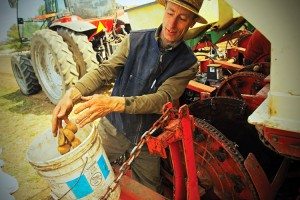
Marcus Koenig, potato grower

Marcus Koenig, potato grower

Marcus Koenig moved his family to Canada from Switzerland to start Klondyke Farms, just north of Corbett, in spring 1997. Today, the farm is an organic operation that supplies a farmers’ market in Toronto and several restaurants, including renowned chef Jamie Kennedy’s chain. Klondyke potatoes can be found in all of their potato dishes, including potato gratin, organic fries, and their famous poutine.
“With our catering business, there are many dishes that go out with his potatoes on a daily basis,” says Michael LeClair, assistant manager of the chain’s Gilead Café. “One of JK’s philosophy’s is everything local and organic. Local definitely comes first for us.”
It’s a philosophy that fits in well with Koenig’s personal story.

As told to Casey Lessard
Photos by Casey Lessard

We had a mixed vegetable, dairy and cash crop farm in Switzerland, very small and very intensive. When we came here, we took over a potato operation that grew roughly 800 acres of potatoes conventionally. I had more and more trouble with chemicals, health-wise. In 2001, it was very bad and I could hardly work. Just by accident, I got a book about a different way to look at the soil from an organic, natural standpoint. That got me started on the organic thing. I needed an eye-opener to see there was another potential way to do it. I couldn’t keep spraying. For us, it was either sell the farm or go organic.
The University of Toronto needed a local (meaning Southwestern Ontario) supplier of potatoes. We are not a large acreage grower, but for an organic grower with 30 to 50 acres of potatoes, we are one of the larger ones. They needed someone who could give them a continuous supply of potatoes. They called me up, and I said they should go to Pfennings, and because they sell my potatoes. They said, “No, we’re not going to do that. When we pay a premium, we want that premium to end up in the producer’s hands. Otherwise, we’re not going to do it.”
I think that’s a very healthy way of thinking, and I was impressed, so we thought maybe we should supply them. They liked our products because we supply them with the varieties they need and we know how each variety behaves in the kitchen. We give them new stuff to try, and if they don’t like it, we don’t supply it. They get what they need and for us, it’s more work because we have to go to Toronto, but we are able to capture the wholesale premium, the delivery premium, and keep it for ourselves. On a long-term basis, we can justify it.
A Toronto farmers’ market focused on bigger volume producers approached us. Most farmers’ markets want people who will supply quarts of apples or quarts of potatoes, but they wanted people who could supply bushels and bigger volumes. I wasn’t really interested in doing it, but they kept asking us if we could come. At exactly the same time, a friend said he would have time to help us part-time on the farm, so we could justify trying it out. We started at the end of September, and we immediately got positive results from it.
The first day, chef Alex Johnston from Jamie Kennedy’s restaurants came and asked what we had. We told him we had potatoes, and he asked how we grow them. We told him we grow organically and use some biodynamic processes. So he took a 50lb. bag home.
The following week he came back to our truck. He’s a very quiet guy and doesn’t talk much. But he was very excited and said, “Hey, we had these potatoes, and these potatoes are awesome. We’re going to buy your potatoes.” We didn’t discuss price. He just said these were the potatoes they were going to buy. That’s it. No discussion.
They take quite a volume, so we gave them our volume discount and that was it. We have done business with them now since last September. I go to his restaurant every week for breakfast and coffee.
We now supply four restaurants in Toronto, including Jamie Kennedy’s chain; we supply all his potatoes. We supply Crush, Cava, and a new restaurant. They’re not all top-end restaurants, but good ones that want to use the potatoes mostly for fries. We have enough sales to justify driving to Toronto on a weekly basis.

A better way of life
I enjoy farming this way better. It’s more independent. In conventional farming, you rely so much on external input. You buy the fertilizer, you buy the chemicals, and the only thing you do is apply the stuff. You supply the land and they take your crop. I never really liked that system because it’s not truly independent. The farmer is the supplier of the soil, but someone else does the managing. It’s going more and more towards that.
Don’t misunderstand me: there are good conventional farmers. This way is more independent because you rely on your own knowledge and your own labour, and you produce your own inputs by composting and animal production. That’s what I enjoy about organic farming.
Also, you have a product that the market wants. I don’t have to go to market and ask, “What will you give me for that?” We are in a strong position: we produce for a market that appreciates our product, and we deal with customers that say, Thank you.
In conventional farming, your customer doesn’t really need you. For them, they are so big worldwide, that one farmer doesn’t make any difference. With organic, you deal with smaller companies that need you, but you also need them. It’s a much healthier relationship between the customer and the producer.
Local food will be way bigger than organic in the future. This is the real way to go. This is going to be the big thing and that will give anybody who produces good stuff on a local level a chance.
Energy has to go that way, too. We should be putting a wind turbine up and one guy can supply our neighbourhood with power from it. The guy who has 1000 pigs should put a manure digester up and produce electricity or natural gas for his neighbourhood. The economic situation now will drive more people to that.
Our so-called leaders talk about how important it is to keep up free trade, but that’s because they’re afraid free trade will collapse. That’s exactly what’s going to happen because it has no future. It gave us all these problems. Worldwide trade and all these products from China gave us the problems we have now. So the solution is to keep going the same way and expect different results? It doesn’t make sense.

Looking for a better future
We as suppliers are not taken very seriously by our suppliers and customers anymore. As a farmer, it is very nice to work with people who appreciate what you are doing. We are not going to get rich quick, but we can survive and increase our wealth slowly. I’m pretty sure I can provide a future for someone down the road.
Every person who lives on this Earth has a purpose, and some people are just born and naturally find their way to that purpose. Some people never find their purpose. I don’t know what my purpose is, but right now, what I could do to bring humanity forward is by supplying good quality food that makes you think straight. Good food, good thoughts; junk food, junk thoughts. It’s that simple.

Posted in Dashwood, Grand Bend, Mount Carmel, News, Parkhill, VIPs0 Comments

Long live the king!

No Gravatar

Grand Bend gambler Richard Webb will travel globe after winning the Canadian Poker Tour crown

Richard Webb hit it big January 21 when he won the Canadian Poker Tour Invitational Finals at Ocean World Resort and Casino in the Dominican Republic. Webb was the best of Canada’s top 43 players, who were invited to the Caribbean resort to compete for the $60,000 title and a sponsorship contract worth $100,000. With the win, Webb will represent Canadian Poker Tour as the Canadian poker champion, and the company will pay his entry fee and all expenses when he competes in tournaments across Canada and around the world this year. He also gets to keep most of his winnings from any tournaments where he places “in the money”. It’s a high level of success for this 48-year old Dashwood native, who grew up playing cards and still plays poker weekly with his friends and family.

Photos and photo illustration by Casey Lessard
As told to Casey Lessard

When did I start playing poker? Probably with my dad when I was a young child. He would deal hand after hand of seven-card stud, and practice and play. He was a card player, and I learned my card skills from him. As we were growing up, we played cards all the time: euchre, solo, hearts – all the card games you play as a family.
Along came the charity casino days, and I played poker at those not knowing much of what I was doing. It was mainly limit poker, so there’s a fixed small blind and large blind, and there are only three or four raises. Each game would be $5 to $20 per game.
We started playing out at a local establishment in Exeter on Monday and Tuesday nights, and we moved out here for a regular Tuesday night poker game (his basement has a poker room complete with a beautiful poker table, comfortable chairs, and a painting of dogs playing poker). We had been playing various types of games, but we could see that no-limit hold ‘em was where the future of poker was. In no-limit, you can raise any time. This was in the fall of 2004 after Chris Moneymaker won the World Series of Poker, which really was the start of the explosion of the poker trend.
In February 2005, I entered my first tournament, the Bluewater Championships at Point Edward charity casino, which was their first. There were about 400 people putting up $500 each. Lo and behold, I finished second. That was a good start. I took a good portion of the winnings and took a month long motorhome trip across Canada with my family.
I played the Bluewater Championships again in February 2006, and won it that time. They had another one in September, and I won that, too. I think first prize was something like $50,000 each, so that set me off. I made headlines in poker magazines, and the international poker rankings mentioned it because it’s unusual to win back-to-back.
In 2007, I made the money again at Bluewater, finishing 12th. Then I went to Regina, where I won a tournament. It’s not the biggest tournament in Canada, but it’s one of the best.
In 2008, I came back and won the Bluewater for the third time. That gave me entry into the Canadian championships, which were put on by the Canadian Poker Tour. They decided to have a tournament for the top point getters throughout the year. In any given year, I’ve never been the top points person, but I’ve always come close. Historically, since I started, I am number one overall.

Canadian championships
It was a very good field of experienced players, all of who had won tournaments or come close, and we played in Puerto Plata. It was well put together with a big reception party. I went through day one, not as the top chip player but as one of the top 12 moving into day two. By the time we got to nine players, I started to take the lead. When we made the final table, I was the chip leader. Not by a lot, but I was chip leader.
I played well. I made two bad calls throughout that time where I actually got in the hand when I was behind. In one case I lost the hand, and the other I drew out on a guy from Toronto. He had an ace/nine versus my king/jack. You get two cards and you’re trying to make a five-card hand. Three cards are flipped – the “flop”. The “turn” brings another card, and then there’s the “river”. I got a jack on the flop to make a pair and that eliminated him.
That was good luck. You want to get in when you’re the favourite. His hand was 55 per cent favoured to my 45 per cent because he had the ace. He had one card that was over my two, but my two were over his bottom card. He had to hit an ace to win. It worked out for me.
I proceeded to knock out the rest of the field. I got down to playing heads-up with a guy named Robert Beveridge, who won two Grey Cups as a CFL player and now coaches football at the University of British Columbia. I trapped him on a hand. I had pocket queens and he had ace/seven. I was 75-80 per cent favoured to win the hand and luckily he got an ace in the flop. The very next hand I picked up pocket sevens and moved all in against his ace/queen. A seven on the flop gave me three of a kind and I won the tournament.
With the $60,000 prize, I get a $100,000 contract to go around the world and play poker. I give them 20 per cent of what I win and I give 10 per cent to charity in the city where I win. If it’s an international win, I’ll donate it in Grand Bend, Dashwood or Calgary, where the Canadian Poker Tour is based.
I’ve worked my schedule so I can still run my business (Stewart Webb & Sons septic systems, which he runs with his brother), and have already started touring. I went to Los Angeles for the LA Poker Classic, which is one of the premier events. The winner takes $1.7 million, and I played well, but didn’t make it into the top 63 to get into the money. I jumped on a plane a couple days later to Calgary and finished 38th, which was in the money, and came home.
I’m going to Regina this month; to Sanremo, Italy in April, to play in the European Poker Tour event there; Calgary for the Canadian Open; Las Vegas for the World Series; Barcelona, Spain; hopefully the North American championships in Niagara; and a whole bunch of tournaments across Canada to represent the tour coast-to-coast.
For the World Series of Poker, there will be 7,000 players putting up $10,000 each, so first prize is about $9 million. Last year there were two Canadians at the final table.

Keeping everything in perspective
Cards are a hobby for me. You see the glamour and glitz on TV, but there’s so much more that goes into it that it isn’t something I would want to have to depend on for rent payments at the end of the month. It would certainly subsidize my income if I decided to retire, but the pressure wouldn’t be there to perform.
I’ve been fortunate. But if I never won another tournament again, I’d be quite satisfied with what I’ve achieved. That said, the Canadian Poker Tour wants me to win. Next year they’re planning to do the same thing but offer contracts to all of the players that make the final table.
If I walk into a poker room anywhere in Canada, they know who I am because of the previous years. I play as hard as I can, but it’s always about the W for me. I don’t look at the money – I look for the win. That might help me be more relaxed at the end, and I think that’s one of my strengths. Plus I have a lot of final table experience.
I wear sunglasses and a hat, and I’m listening to music a lot of the time. I try to establish how good someone’s hand is, and if I’m right 60 per cent of the time, I’m doing well.
The more hands you see, the better. In no-limit poker, there’s raising (the stakes) and folding (your hand); no calling. Calling will just get you into trouble unless you’re trying to trap somebody. A good fold is as good as a good call. Maybe better. You’ve got to be able to fold when you’re beat. If you don’t, you’re going to be out of the tournament in a hurry.
It doesn’t matter if it’s for $10 or $10,000; it’s still about winning. I still like to play. Cards are a social sport. At tournaments, you’re sitting at tables for 10-12 hours, so I want to be able to talk to the person next to me. If you’re likable, maybe people don’t try to knock you out as hard. I always shake hands and say goodbye to everyone.
I’m definitely living the dream. It’s always nice to take Jackie and Sarah with me to places where it’s nice and warm, or places they want to see. Jackie will be going with me to Italy, and hopefully Jackie and Sarah will go with me to Barcelona. When I’m there playing, I don’t do anything other than play, but if I take an extra week, we can enjoy the places together. The money I’ve won has been used for things for my family and extended family, so it goes to good use and isn’t wasted.
We still play every Tuesday night with the boys, and they beat me all the time. I play with my father every Tuesday and he beats me quite regularly. I like the ability to play with my dad. I’ve taken him to some tournaments; he sees the success I’ve had, and he’s proud of that.
If I win $50,000 Sunday night, I still go to work Monday morning. If I were given a long-term contract to represent an organization, I probably would take it. I like the ability to get out there and meet people. If they want me to do charity events, I’m happy to do it. If I have interviews to do, I’m happy to do that. If I win one of the big tournaments this year, it’s not going to change the way I am and I’ll probably still come to work the next day. Well, maybe I’d take a couple days off before coming back.

To see Richard Webb win the Canadian Poker Tour Invitational Finals, you can watch The Score in April. Air dates and times are not yet set, but will be listed at thescore.com

Posted in Dashwood, Entertainment, Grand Bend, News, VIPs0 Comments

A cool way to start married life

No Gravatar

Tim Hoffman of Dashwood and Cathy Costello of Mitchell met through a mutual friend two years ago, and started dating. They got married February 14 on a three-layer cake made of snow as part of the Grand Bend Winter Carnival.

Interview & photos by Casey Lessard

Take me back to when you first met.
Tim: It was a blind date, so I had no idea what she would look like. You never know what to expect, but it was good. We had good conversation that night and everything went well, and when I left, she told me to come and give her a hug.
Cathy: He was a gentleman. Very nice. He seemed really down to earth. He deserved a hug.

The first date is one thing, but what was the impetus to say this is going to work?
C: I brought him to a party with the girls I work with, and the Mitchell girls are pretty wild. He fit right in with them. It was very important that he could put up with their craziness.
T: They all seemed to enjoy a good time and were fun to be around. Then Cathy came up and gradually met my family more and more and fit in really well.

Family is really important to both of you. What was it like to think about merging the two?
C: We just felt it was the next step to take. I was ready to move out of Mitchell, out of the small town – and into another small town. We were driving a lot; he came up pretty much every night to Mitchell. We just thought it would make more sense to be in the same household.
T: As time goes on, you can see you will be compatible together and it makes sense to take the next step.

What were you looking for? What was special about Cathy?
T: Someone who takes interest in what I do, and we can have a good time together and laugh together.

What was special about Tim?
C: He had to be compatible with my daughter Olivia. Whenever they met, they just clicked. That was nice to see.

Cathy, you had a family already. How did that play into things?
C: It was hard. I didn’t trust many people. I could see with Tim that he was a genuinely nice guy and treated her and me with respect.
T: I just tried to be a good role model for Olivia and build a family with them.

How did you propose?
T: We were going on a camping trip to Tobermory last August, and I knew prior to the trip that I would do it. There’s a high cliff on the Bruce Trail, and it’s the most beautiful spot that I’ve ever seen. There’s nothing manmade as far as you can see. Years ago, before I had met Cathy, I said that would be the spot if I ever had to propose.
We had quite a challenging time to get to that point. It was a holiday weekend, so you had to take a narrow provincial park road and I was towing a big trailer. It was pretty much impossible for two cars to go side-by-side. Someone pretty much ran me off the road and I ended up getting stuck in the gravel going partway up the hill. We thought we were going to be there for the day. Finally, a bunch of good old Canadian boys came along and gave us a push out.
We got it out and got over the hill, and we couldn’t go any further because there were all these cars parked there. So we pulled off the side as far as we could and went swimming. When I went back to the truck, the cars were gone and I was able to move the truck to the parking lot.
I told Cathy I wanted to go for a hike before it got dark, and luckily enough, Cathy, Olivia and my nephew were willing to go. Olivia was apprehensive because she didn’t want to walk, but she got in her head that she was going to be the leader and she beat us to the top.
Once we got to the high cliff, I told the kids I needed to talk to Cathy in private for a minute.
C: I didn’t know what was going on. We had gone up the trail the year before and up to the cliff. He shooed the kids away and proposed. It was very sweet. Olivia didn’t know what to think, but she was fine. She gave Tim a big hug and she was happy.

Then this contest comes up. Whose idea was it to enter?
C: We had gone out to supper with a bunch of people from his work, and the whole month before they had been saying, You’ve got to enter. They were on us all night long and we came home and decided to put our names in. We didn’t think too much about it.
I was at work and it was 7:50 a.m. They said “Cathy Costello, Line 1.” I picked up and the voice said, This is so-and-so from 104.9 The Beach. Do you have a few minutes to talk to us? I was like, not really, I’m at work. I tried my best to get out of the phone call, but he said he would call back in half an hour. My heart was racing the whole time. All the girls were wondering what was wrong with me.
They called back and gave me the spiel about how we had won and would be the couple on the cake. I went to my supervisor and asked if I could make a long-distance call to Tim. His boss answered and she started screaming. It was crazy.
T: We had only entered the week before and the wedding was two weeks later.
C: We hadn’t told anyone at all that we had entered. People were calling and it was crazy that day.

The big day comes around, and you’re on a big snow cake. What was it like?
C: I was really nervous until I got on top of the cake and it was so calm and quiet up there. It was fine once we were up there.
T: You’re kind of apprehensive about the crowd of strangers watching you, but it was just us up there.

What was most interesting about getting married on the snow cake?
T: Getting Cathy known in the community. Everyone’s going to know her now! We pretty much went for a month straight being on the front page of the paper.
C: At the time, it was so completely stressful, but I look back now and think it was a cool way to do it.

Tim and Cathy will have another wedding this summer. They are thankful for the work of Linda Hillman-Rapley and Diana Simpson for organizing the wedding.

Posted in Dashwood, Grand Bend, VIPs0 Comments

Subscribers see ALL our stories – Login/Register:

The Big Question:

Photos on flickr